Brazil wire thickness standard
In Brazil, nail sizes are traditionally labeled in JP x LPP units, where JP (Jauge de Paris) denotes the diameter (thickness) gauge and LPP (Linha de Polegada Portuguesa) multiplies by a constant (~2.3 mm) to find the length. For example, a 18 x 27 nail has a 3.4 mm diameter and a 62.1 mm length.
Common Brazilian Nail Sizes (JP x LPP to mm) is very important.
Understanding the Units
- JP (Diameter Gauge): An arbitrary numerical scale (1 to 30) corresponding to wire thickness rather than a direct millimeter measurement.
- LPP (Length Unit): Each LPP unit equals approximately 2.3 mm. Multiplying the LPP number by 2.3 mm gives the total length in millimeters.
Common Brazilian Nail Sizes Conversion Table
| JP x LPP Size | Diameter (mm) | Length (mm) | Common Use / Description |
|---|---|---|---|
| 8 x 8 | 1.3 mm | 18.4 mm | Very light crafts, small trim |
| 10 x 10 | 1.7 mm | 23.0 mm | Light woodwork, small moldings |
| 12 x 12 | 2.1 mm | 27.6 mm | General light carpentry |
| 15 x 15 | 2.4 mm | 34.5 mm | Standard general-purpose utility |
| 15 x 21 | 2.4 mm | 48.3 mm | Box boards, light framing |
| 17 x 21 | 3.0 mm | 48.3 mm | Medium carpentry, furniture |
| 17 x 27 | 3.0 mm | 62.1 mm | General construction, fastening planks |
| 18 x 27 | 3.4 mm | 62.1 mm | Heavy wood structures, framing |
| 18 x 36 | 3.4 mm | 82.8 mm | Roof structures, heavy carpentry |
| 19 x 27 | 3.9 mm | 62.1 mm | Thick structural timber |
| 19 x 36 | 3.9 mm | 82.8 mm | Heavy framing, robust construction |
| 20 x 33 | 4.4 mm | 75.9 mm | Heavy timber, heavy-duty building |
If you have a specific JP x LPP size that is not listed here, or if you need to convert it to the alternative Inch x BWG system, let me know!
Description détaillée
D’origine française, la Jauge de Paris est un outil simple et efficace utilisé dans divers secteurs industriels pour mesurer avec précision le diamètre des fils métalliques, contribuant ainsi à assurer la qualité et la conformité des produits fabriqués.
La jauge se présente sous la forme d’un double décimètre pliant ou d’un disque étalonné et marqué avec des graduations.
Pour mesurer le diamètre d’un fil d’acier, l’opérateur place le fil sur l’outil, à l’endroit qui correspond le mieux au diamètre du fil. Une fois la correspondance trouvée, le diamètre du fil est lu à partir de la graduation sur la jauge.
CORRESPONDANCE ENTRE JAUGE DE PARIS ET DIAMETRE DU FIL
La Jauge de Paris (JDP) est un ancien outil de mesure qui permettait de trouver le diamètre des fils.Utilisée au Moyen Age, elle servait aux marchand de fer et à tous les artisans utilisant du fil.Aujourd’hui encore on exprime parfois le diamètre du fil en Jauge de Paris.
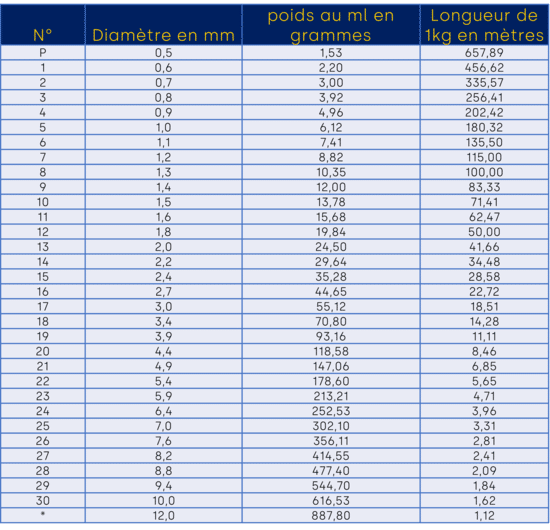
Le lien ci-dessous vous permet d’accéder au simulateur pour calculer la longueur d’une bobine de fils en acier en fonction du diamètre du fil.
Calculer la longueur d’une bobine de fil
Simulateur développé par C.E.P.- Consulting